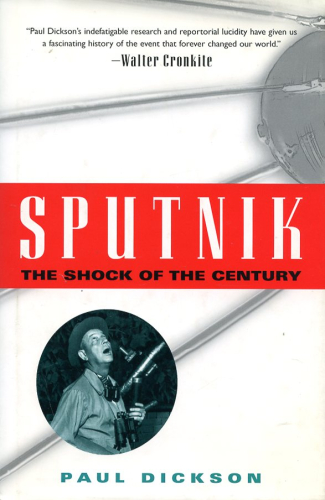
Sputnik
The Shock of the Century
Dickson, Paul
First Edition. First Printing. On October 4, 1957 as Leave It to Beaver premiered on American televisioh.the Soviet Union launched the first man-made object into space, a 184-pound satellite carrying only a radio transmitter. While Sputnik l immediately shocked the World its long-term impact was even greater, for it profoundly changed the shape of the twentieth Century. Washington Journalist Paul Dickson chronicles the dramatic events and developments leading up to and emanating from Sputnik's launch - a story that can only now be fully told with the recent release of previously classified documents. Sputnik offers a fascinating profile of the early American and Soviet space programs and a strikingly revised picture of the politics and personalities behind the facade of America's fledgling efforts to get into space. Although Sputnik was unmanned, its story is intensely human. Sputnik owed its success to many people, from the earlier visionary Konstantin Tsiolkovsky, whose rocket theories were ahead of their time, to the Soviet spokesmen strategically positioned around the world on the day the satellite was launched, who created one of the greatest public-relations events of all time. Its chief designer, however - the brilliant Sergei Korolev - remained a Soviet state secret until after his death. Equally hidden from view was the political intrigue dominating America's early space program, as the military services jockeyed for control and identity in a peacetime world. For years, former Nazi Wernher von Braun, who ran the U.S. Army's missile program, lobbied for his rocket team to be handed responsibility for the first Earth-orbiting satellite. He was outraged that Sputnik beat him and America into space. President Eisenhower, though, was secretly pleased that the Russians had launched first, because by orbiting over the United States Sputnik established the principle of "freedom of space" that could justify the spy satellites he thought essential to monitor Soviet missile buildup. As Dickson reveals, Eisenhower was, in fact, much more a master of the Sputnik crisis than he appeared to be at the time and in subsequent accounts. The U.S. public reaction to Sputnik was monumental. In a single weekend, Americans were wrenched out of a mood of national smugness and post-war material comfort. Initial shock at and fear of the Soviets' intentions galvanized the country and swiftly prompted innovative developments that define our world today. Sputnik directly or indirectly influenced nearly every aspect of American life,from the demise of the suddenly superfluous tail fin and an immediate shift toward science in the classroom to the arms race that defined the Cold War, the establishment of NASA, the comp£tition to reach the Moon, and the birth of the Internet. The launch of Sputnik was one of the pivotal moments of the twentieth Century. In telling its story, Paul Dickson sheds new light on our understanding of the last fifty years and offers an invaluable addition to the history of technology and the Space Age.
Hardcover with dust jacket
310 Seiten / pages
photos
very good condition, with an name sticker of the previous owner
New York - 1998 - Springer Verlag
Art.Nr. 25850