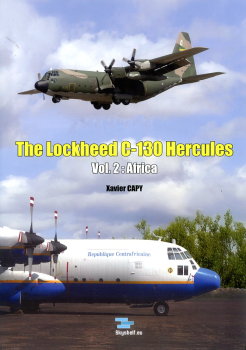
Capy, Xavier
Africa is the continent of the C-130 par excellence. Alternately a vehicle for projecting force, a tool of soft power, a humanitarian ally, and a generator of economic development, the C-130 has fulfilled the most comprehensive range of missions imaginable. Whether killing terrorists in Somalia or creating jobs in Morocco, it is always the C-130 that is called upon to evacuate Western nationals from countries ravaged by civil war or coups d'état, and it is always the C-130 that drops pallets of food or medicine to populations struck by famine or natural disasters. The second volume in Xavier Capy's series on the Lockheed C-130 around the world, this book takes a close look at the Hercules' fantastic history in Africa. The African continent currently has 54 sovereign states, only 16 of which use – or have used – the C-130 Hercules. Unsurprisingly, the North African countries located around the Mediterranean are all equipped with C-130s and also have the largest fleets. It was also in North Africa that the C-130J-30 Super Hercules made its debut on the African continent: first in Tunisia, then more recently in Algeria, with Egypt set to acquire them soon. With the delivery of nine C-130Bs in 1963, the South African Air Force became the first African force to fly the Hercules. It was also one of the American manufacturer's first export customers. Then, in the 1970s, several other African air forces joined them: Libya in 1970, Zaire in 1971, Morocco in 1974, Gabon and Nigeria in 1975, Egypt in 1976 (which is still the largest user on the continent), Cameroon in 1977, Sudan in 1978 and Niger in 1979. All aircraft delivered were of the "C-130H" type, the latest version of the four-engine turboprop aircraft specially designed for export. Apart from the Central African Republic, Sudan and Zaire, which no longer have any Hercules aircraft in service, the thirteen other air forces are still believed to have C-130s in operation. However, the following pages show that, in the case of many African countries, information is fragmentary or even non-existent, and it is very difficult to know whether these fleets are actually operational: there are many aircraft stored in varying states of repair or grounded – awaiting overhaul or due to a lack of spare parts, sometimes for long periods due to budgetary concerns – and it is unclear whether they will ever fly again. 157 aircraft for 16 operators
Softcover, large format
184 Seiten / pages
many photos and maps
very good condition, new book
Dilbeek, Belgium - 2025 - Skyshelf.eu
Art.Nr. 25770